
What Does Concrete Slump Mean and Why Does It Matter?
September 10, 2026
Concrete slump indicates how workable and fluid freshly mixed concrete is, making it an important consideration when ordering ready mixed concrete in Newcastle. The right slump helps concrete flow, compact and finish properly, while an unsuitable consistency can make placement difficult and affect the quality of the finished surface.
Understanding slump also helps explain why concrete mixes are specified differently for slabs, footings, driveways and structural elements. Factors such as mix design, water content, weather, transport time and placement methods can all affect slump and how concrete behaves on site.
Maitland Ready Mixed Concrete helps customers understand the importance of choosing a concrete mix with a slump suited to the project and site conditions. Understanding how slump is measured and what it means for workability, strength and placement can help support a successful and durable concrete pour.
The standard concrete slump test is a simple field test used to assess the consistency and workability of freshly mixed concrete. It measures how much the concrete subsides after a standard cone-shaped mould is lifted, indicating the mix's consistency at the time of testing.
The test is commonly used when fresh concrete is sampled for quality control or when required by the project specification. It provides a quick, measurable result that can be compared with the specified requirements for the concrete.
A slump test can help indicate:
Concrete needs to be workable enough to fill formwork and surround reinforcement without excessive effort, while remaining cohesive enough to avoid unnecessary bleeding or segregation. A very low slump can make compaction difficult, while an unexpectedly high result may indicate a mix change that needs investigation.
Importantly, slump does not directly measure concrete strength or overall quality. It is an indicator of fresh concrete consistency and should be considered alongside the concrete grade, mix design, water-cement ratio, admixtures and placement requirements.
Concrete slump is measured by placing freshly mixed concrete into a standard slump cone, removing the cone and measuring how far the concrete settles. The result is recorded in millimetres and provides an indication of the consistency of the fresh mix.
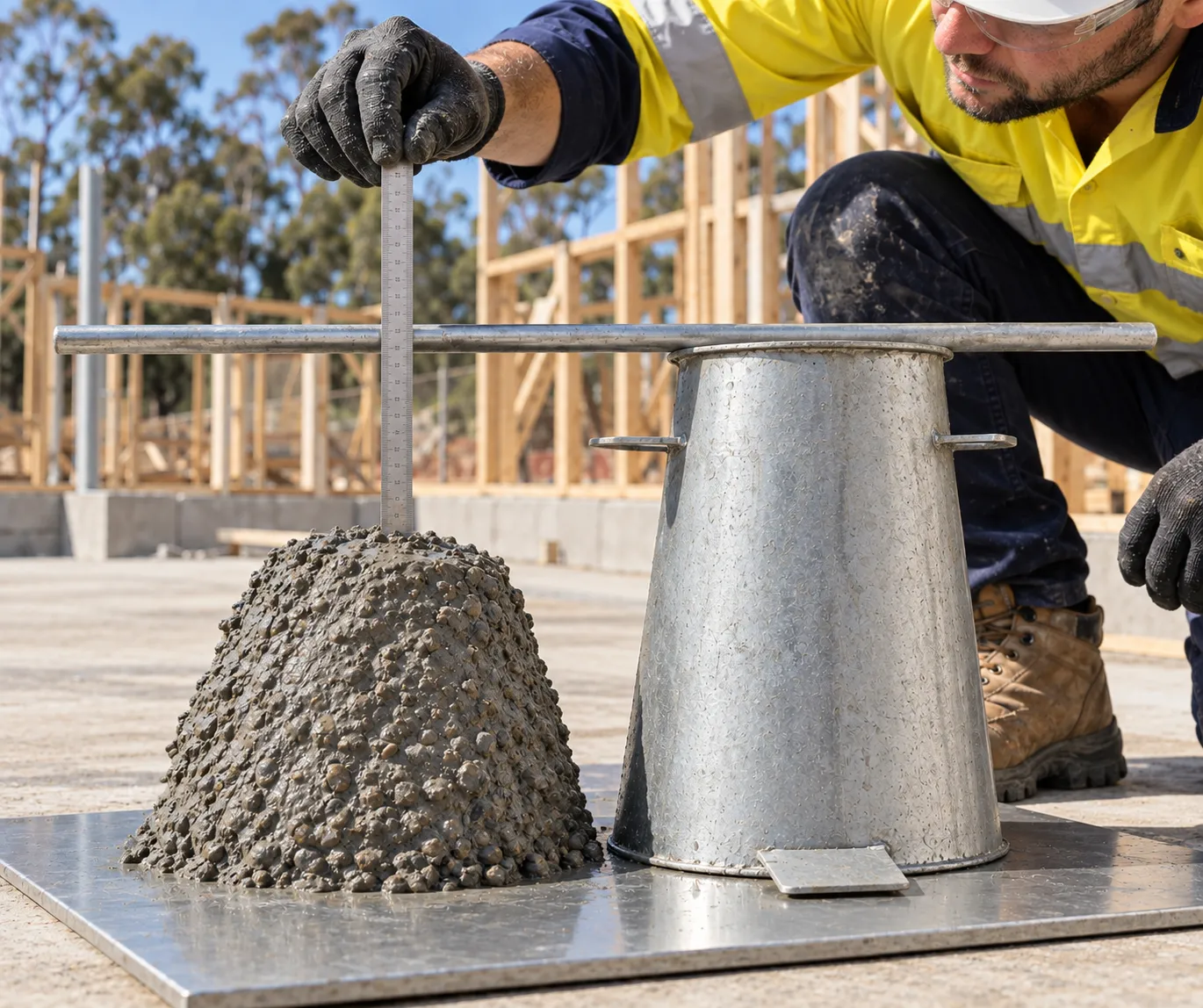
The test needs to be performed consistently to produce a meaningful result. The basic process involves:
The shape of the settled concrete can also provide useful information. A true slump generally settles evenly, while a shear slump breaks away to one side and may require the test to be repeated. A collapse slump, where the concrete spreads significantly, may indicate that the standard slump test is not suitable for that particular mix or consistency.
Testing should be carried out promptly after sampling and in accordance with the applicable testing procedure. If the result falls outside the specified range, the concrete should be assessed before placement rather than automatically adjusted with water.
Slump provides an indication of how easily fresh concrete can be placed, compacted and finished. A higher slump indicates a more fluid mix, while a lower slump indicates a stiffer consistency.
Neither is automatically better. The appropriate slump depends on the application, reinforcement, formwork, access conditions, placement method and finishing requirements. The aim is to achieve enough workability for the concrete to be placed and compacted effectively without unnecessarily changing the designed mix.
Higher-slump concrete is more fluid and can make placement easier where the concrete needs to flow around reinforcement, into complex formwork or through difficult access areas. It can be useful for applications such as:
However, a higher slump should come from an appropriate mix design rather than uncontrolled water additions. A high slump achieved through suitable admixtures can have very different implications from a high slump caused by adding excessive water.
Suitable modern concrete admixtures can increase workability and flow without relying on uncontrolled additions of water.
Lower-slump concrete is stiffer and provides greater shape retention during placement. It can be suitable for applications such as:
The trade-off is that low-slump concrete can require more effort or mechanical compaction. If the mix is too stiff to consolidate properly, trapped air and voids can affect the finished concrete.
The suitable slump should therefore be determined by the requirements of the project rather than simply choosing the highest or lowest value.
Slump and concrete consistency are closely related, but they describe different things. Consistency refers to how stiff, fluid or cohesive freshly mixed concrete is, while slump is the numerical measurement obtained from the standard slump test.
Consistency describes the practical behaviour of fresh concrete and influences how easily it can be placed, compacted and finished. A more fluid mix flows more easily, while a stiffer mix provides greater resistance to movement.
The appropriate consistency depends on the application and how the concrete will be placed. A driveway, for example, may have different workability requirements from a heavily reinforced structural element.
Slump gives a numerical indication of consistency that can be compared with the specified requirements for the project.
However, slump is not a direct measure of concrete strength. Two mixes can have the same slump while having different concrete grades, mix proportions and performance characteristics.
Likewise, a higher slump does not automatically mean weaker concrete. Workability can be increased through suitable mix design and water-reducing admixtures without unnecessarily increasing the water-cement ratio.
Understanding the distinction helps ensure that slump is used for what it is intended to do: provide an indication of fresh concrete consistency and workability rather than act as a standalone measure of concrete quality.
The Cement Concrete & Aggregates Australia Guide to Concrete Construction provides further information about concrete mix design, workability, handling, compaction and quality testing.
Different concrete projects require different levels of workability. The appropriate slump depends on the concrete element, reinforcement, formwork, placement method and finishing requirements.
Rather than applying a universal slump value to every project, the required consistency should be specified according to the conditions in which the concrete will be placed.
Lower-slump concrete is relatively stiff and can provide good shape retention. It may be suitable for applications such as:
Because it is less fluid, it may require more effort to place and compact effectively. Proper consolidation remains important to prevent voids and honeycombing.
Medium-slump mixes can provide a balance between workability and shape retention and may be used for general applications like:
The exact slump should still be selected according to the project's requirements rather than treated as a universal value for these applications.
Higher-slump concrete can be useful where greater flowability is needed, including applications involving congested reinforcement, complex formwork or pumping.
It may suit applications such as:
Where higher workability is required, the mix should be designed to achieve it without unnecessarily increasing the water-cement ratio. Suitable admixtures can often improve flow while maintaining the required mix proportions.
Concrete slump itself does not directly determine strength. The important consideration is what causes the concrete to have a particular slump.
Understanding the factors that make concrete strong also helps explain how the water-cement ratio, mix design, compaction and curing influence the finished result.
Adding excess water increases slump but also raises the water-cement ratio. This can reduce compressive strength, increase permeability and contribute to shrinkage and cracking. For this reason, slump should be achieved through the specified mix design rather than uncontrolled water additions.
A higher slump does not necessarily mean weaker concrete. Suitable water-reducing admixtures can improve workability without adding excessive water, allowing a higher-slump mix to achieve the required strength when it has been properly designed, placed, compacted and cured.
Similarly, a low slump does not automatically mean stronger concrete. If concrete is too stiff to be properly compacted, trapped air and voids can compromise the finished result.
Adding water can make concrete easier to work with and increase its slump, but excessive water can affect the properties of the hardened concrete. Increasing the water-cement ratio can reduce strength and increase permeability, while also contributing to shrinkage, bleeding and surface problems.
The required slump should be achieved through the correct mix design rather than uncontrolled water additions on site.
When excess water eventually leaves the concrete, it can leave additional pores within the hardened cement paste. This can increase permeability and reduce strength.
Higher water content can also increase drying shrinkage, which may contribute to cracking. Increased permeability allows moisture and other aggressive substances to penetrate more easily, which can affect long-term durability.
Adding water may therefore improve workability in the short term while creating unwanted changes to the concrete's designed properties.
If concrete arrives with a lower-than-expected slump, adding water should not be the automatic solution. The specified slump should first be confirmed and the load assessed in accordance with the mix requirements and supplier's instructions.
Where additional workability is required, an approved water-reducing admixture may be appropriate depending on the mix and project requirements. These admixtures can improve workability without introducing the same increase in water-cement ratio associated with simply adding water.
Maintaining the specified mix proportions helps ensure concrete remains workable enough to place and compact while retaining the required strength and durability.
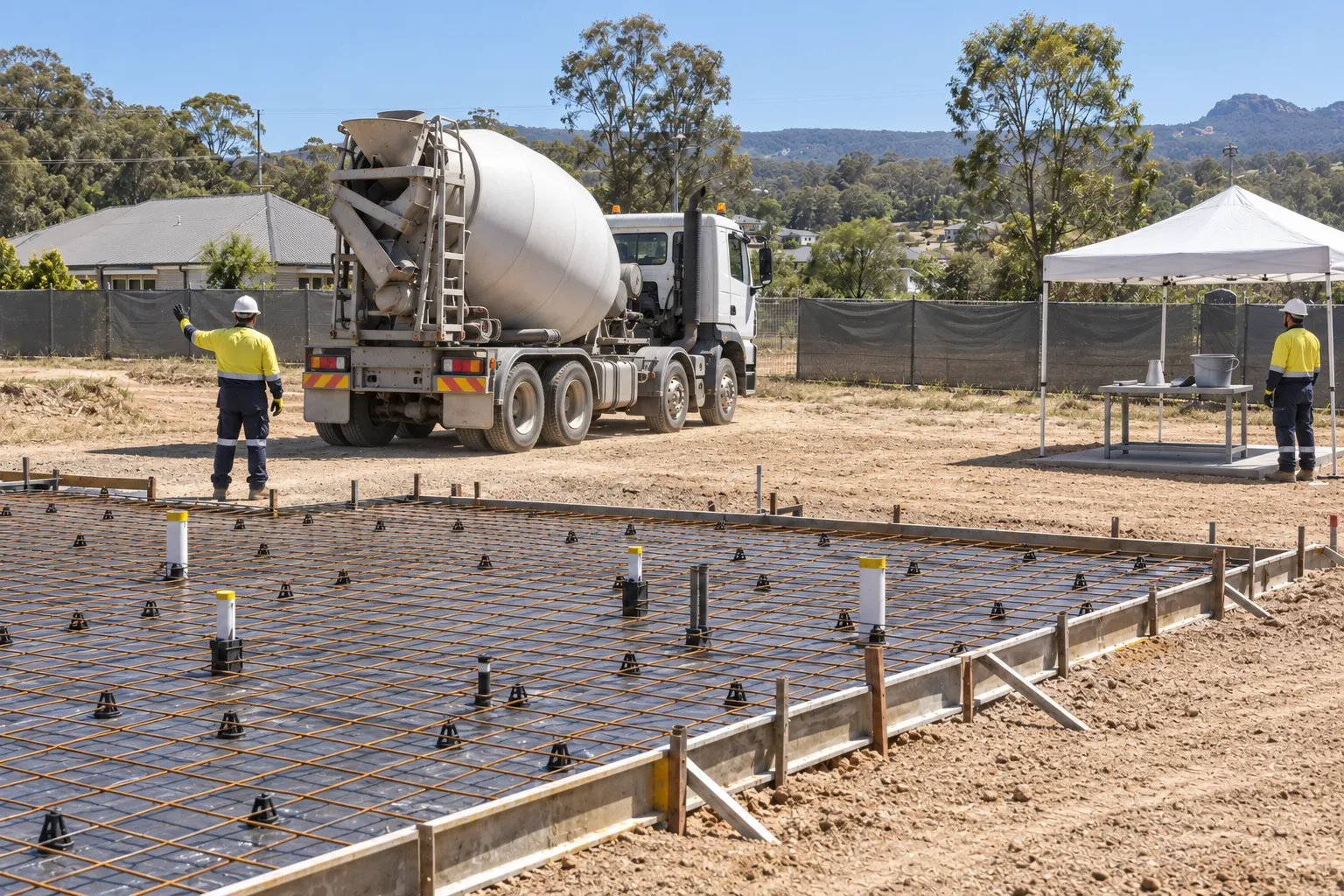
Concrete can leave the batching plant within its specified slump range but behave differently by the time it reaches the job site. Time, temperature, water additions, mixing and site conditions can all influence its consistency.
Here are factors that can affect concrete slump:
Where pumped placement is required, Safe Work Australia provides guidance on managing concrete pumping risks, including equipment selection, pipelines, exclusion zones and worker protection.
If the concrete appears noticeably different from the specified consistency, it should be assessed before placement. Investigating the cause is preferable to simply trying to make the mix wetter or stiffer without considering its designed properties.
Yes, when required by the project specification or quality-control process. Checking slump before placement provides an indication of whether fresh concrete has the expected consistency for the intended application.
This can help identify an unsuitable or unexpected load before the concrete is committed to the finished pour. It can be useful where removing or replacing incorrectly placed concrete would be difficult and costly.
The frequency of testing depends on the project requirements and circumstances of the pour, so not every load will necessarily require an individual test.
If a slump result falls outside the specified range, it should be verified and assessed before placement rather than automatically corrected with water. The supplier or responsible site personnel can determine whether the load is suitable, requires an approved adjustment or should be rejected.
Slump testing is most useful when considered alongside the concrete grade, mix design and placement requirements. It provides one part of the broader quality-control process used to help achieve proper placement and consolidation.
Yes, concrete slump can change during transport and placement. Fresh concrete stiffens as hydration progresses, while travel time, temperature, site delays and handling can also influence its consistency.
As a result, concrete that meets the specified slump when tested after batching may have different workability later in the delivery process. The extent of the change depends on the mix, admixtures, environmental conditions and time between batching and placement.
Good site planning can help minimise unnecessary changes. Having the formwork, reinforcement, equipment and work area ready before delivery reduces waiting time, while coordinated crews and suitable discharge or pumping arrangements can help maintain efficient placement.
If concrete appears different from the specified consistency, it should be assessed before placement rather than simply adding water. Managing delivery and placement effectively helps maintain the intended workability and supports proper compaction and finishing.
Understanding concrete slump helps ensure fresh concrete has the right consistency for efficient placement, compaction and finishing. The appropriate slump depends on the application, mix design, reinforcement, formwork and placement method, rather than simply being a matter of choosing a higher or lower value.
Factors such as water content, weather, transport time and site handling can all affect slump, so uncontrolled water additions should be avoided. Maitland Ready Mixed Concrete can help customers select concrete suited to their application and site conditions, supporting the strength, durability and performance expected from the finished project.
Call our friendly and highly experienced team today to get your concrete, sand, aggregate, and landscaping products.
-1.png)

