
How Long Before You Can Drive on New Concrete?
September 9, 2026
Knowing when new concrete is ready for vehicles is important for protecting its strength, appearance and performance. Driving or parking on a slab too soon can cause cracking, surface damage and tyre marks, while waiting unnecessarily can leave a completed driveway out of use.
For projects using ready mixed concrete in Newcastle, factors such as the mix design, slab thickness, weather, curing conditions and vehicle weight can all affect how soon a residential driveway or similar concrete slab is ready for traffic. Understanding these factors helps property owners plan access and avoid damage during the early stages of curing.
Maitland Ready Mixed Concrete helps customers understand the curing process and the conditions that affect concrete strength. The following guide covers typical curing timeframes, how different vehicle loads affect new concrete and practical ways to protect a new driveway as it gains strength.

New concrete needs to develop sufficient strength before vehicles can safely drive or park on it. The appropriate waiting period depends on the concrete mix, slab thickness, curing conditions and vehicle weight, so a surface that feels hard is not necessarily ready for traffic.
For a standard residential driveway using a 20 MPa to 25 MPa mix in suitable conditions, these timeframes provide a guide:
Concrete continues gaining strength beyond the first week. Twenty-eight days is commonly used as the conventional age for assessing specified compressive strength, but it does not mean every driveway needs to remain unused for 28 days. The appropriate traffic-opening time depends on the concrete specification, slab design and intended load.
Concrete does not reach its full strength as soon as it feels firm. Strength develops progressively over the following weeks, with the first seven days particularly important for protecting the slab from premature traffic, moisture loss and temperature extremes.
While the exact timeframe depends on the mix, slab design, weather and curing conditions, a typical residential driveway follows this progression:
The Cement Concrete & Aggregates Australia Guide to Concrete Construction provides further technical information about curing, compaction, cracking control and concreting in different weather conditions.
During the early curing period, cement reacts with water to form the hardened structure that gives concrete its strength. Proper curing helps control moisture loss and supports consistent strength development.
Understanding the factors that make concrete strong can also help explain why mix design, water content, compaction and curing all influence when a slab is ready for traffic.
Concrete can continue gaining strength after 28 days, so this milestone should not be treated as the point when curing suddenly ends. Instead, the question is whether the slab has developed enough strength for its intended use and vehicle load.
Yes, the type and weight of the vehicle can affect how soon new concrete is ready for traffic. Cars and small SUVs place less stress on a new driveway and may be suitable after around 7 days under favourable conditions. Heavier utes, vans, caravans and trailers create greater loads and should be kept off for around 10 to 14 days or longer, depending on the slab design, mix and curing conditions.
Heavy trucks, buses and construction equipment require greater consideration and should only use concrete designed to handle those loads. Regular heavy vehicle traffic may require a thicker or reinforced slab and a longer curing period, with access determined by the concrete and pavement specification.
Even after vehicle access is permitted, avoiding sharp turns, sudden braking and heavy parking close to slab edges can help protect new concrete. When the intended vehicle is heavier than normal domestic traffic, the contractor or concrete supplier should confirm when the slab is ready for use.
Yes, concrete can usually support light foot traffic before it reaches its full 28-day strength, but vehicles require more time. For a typical residential slab, light walking may be possible after around 24 to 48 hours, provided the surface has hardened properly and is not easily marked. Heavy objects, wheeled equipment and unnecessary traffic should still be avoided during the early curing period.
Cement Australia’s guidance on laying and curing a concrete slab recommends starting the curing process promptly and avoiding heavy loads during the early strength-development period.
Parking is different because a vehicle places concentrated and sustained loads on the slab. A light passenger vehicle is better kept off a new residential driveway for around 7 days, while heavier utes, vans, caravans and trailers may require 10 to 14 days or longer. Parking or turning too soon can cause tyre marks, depressions, cracking or damage to vulnerable edges.
If temporary vehicle access is unavoidable, the appropriate timeframe should be confirmed with the contractor or concrete supplier based on the mix, slab design and curing conditions. Planning access before the concrete is poured can help ensure the slab is suitable for its intended use and that sufficient time is allowed for it to develop strength.
You cannot reliably tell if concrete is ready for driving simply by looking at it or checking whether it feels hard. A slab may appear dry and solid while still developing the strength needed to handle vehicle loads. Its curing age, specified strength, curing conditions, slab design and intended vehicle should all be considered.
For a typical residential driveway, light vehicle access may be suitable after around 7 days under favourable conditions. However, cooler weather, difficult curing conditions or heavier vehicles can mean more time is needed.
A basic surface inspection can identify obvious signs that the concrete is not ready, although it cannot confirm its structural strength. Look for:
If the surface is easily marked or damaged, vehicle access should be delayed. A driveway that is suitable for a small car may also not yet be ready for a loaded ute, caravan, trailer or truck.
The safest approach is to follow the recommended traffic-opening time provided by the contractor or concrete supplier. If the vehicle load or project is unusual, professional confirmation can help ensure the slab has developed sufficient strength before access is allowed.
Driving on concrete before it has developed enough strength can cause surface and structural damage that may be difficult and costly to repair. Although the slab may look firm, premature vehicle loads can affect the concrete before it has finished developing its strength.
Problems caused by driving too soon include:
The risk is greater with heavier vehicles or where the slab has not been properly designed, supported or cured. Damage caused by premature traffic may require more than a simple surface repair, with severely affected areas needing to be removed and replaced.
Allowing the recommended curing period is therefore one of the simplest ways to protect a new driveway. Keeping vehicles off the slab until it has developed sufficient strength helps preserve the finish and reduces the likelihood of premature cracking, surface damage and expensive repairs.
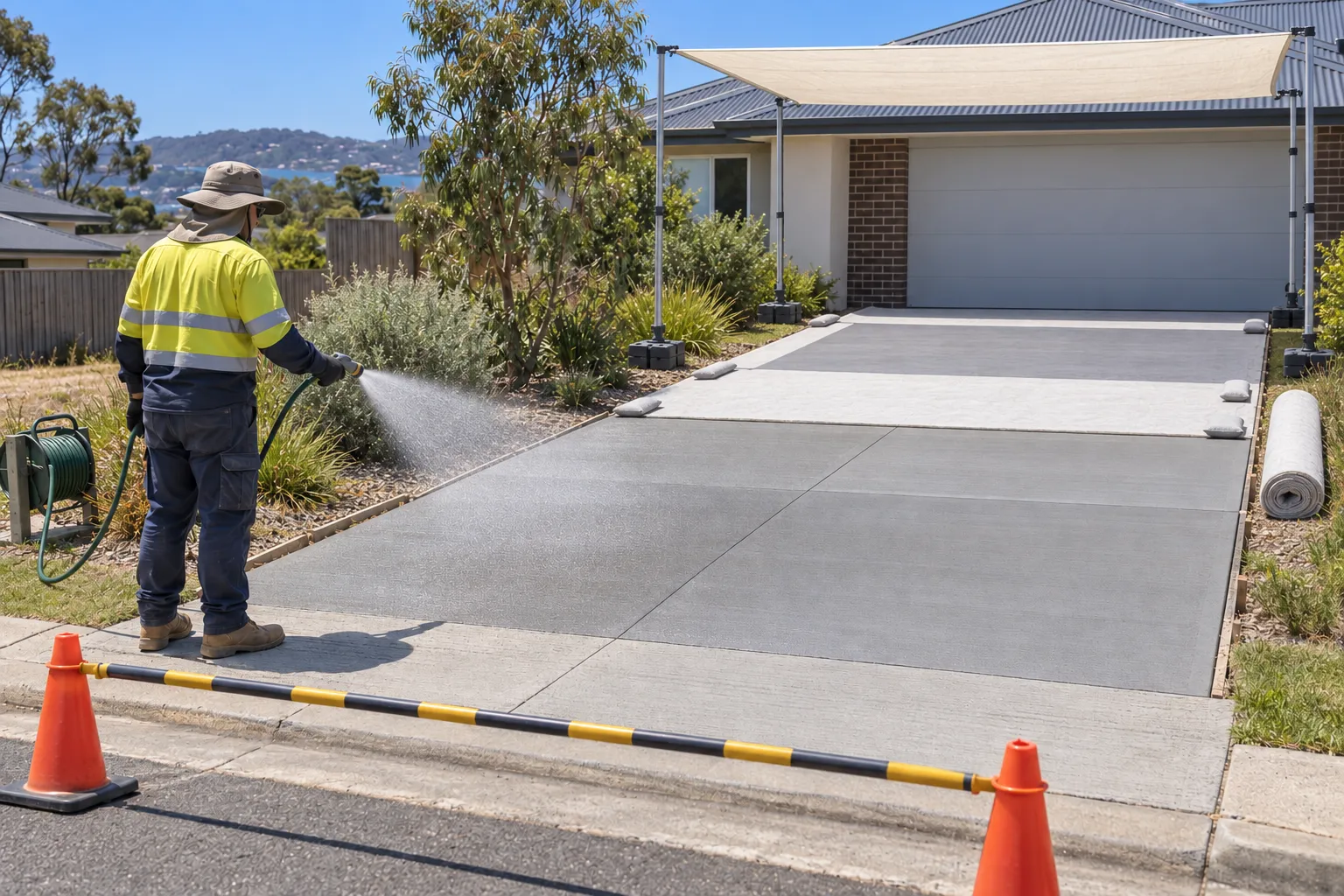
Protecting new concrete during its early curing period helps it develop strength properly and reduces the risk of cracking, surface damage and premature wear. The first week is important, as the slab is still vulnerable to excessive drying, temperature changes and vehicle loads.
Concrete needs moisture to continue developing strength. In hot, dry or windy weather, follow the recommended curing method to prevent the surface from drying too quickly. Depending on the project, this may involve controlled water curing or suitable coverings like plastic sheeting or damp hessian.
Using proper concrete curing methods helps maintain suitable moisture and temperature conditions while the slab develops strength.
The slab should also be protected from extreme temperature changes during the early curing period. Follow the contractor or concrete supplier’s recommendations for the conditions at the time of the pour.
Avoid vehicle traffic until the concrete has developed sufficient strength for the intended load. Light pedestrian access may be possible after around 24 to 48 hours, while light vehicles commonly require around 7 days and heavier vehicles may need 10 to 14 days or longer.
Do not place heavy items such as skip bins, building materials, caravans or portable structures on the slab prematurely. Temporary barriers or signage can help prevent vehicles and equipment from accidentally accessing the area.
Avoid dragging tools, ladders or equipment across the new concrete and keep construction activities that could damage the surface away from the slab where possible. Fuel, oil, paint and other chemicals should also be kept off the curing surface.
If other work is continuing around the driveway, protect access paths and prevent concentrated runoff from pooling on or washing across the slab. These simple precautions can help maintain the concrete’s finish while it develops the strength needed for regular use.
Following the recommended curing and access requirements provided by the contractor or supplier is the safest way to protect the new slab during its early stages.
Yes, asking a concrete professional is recommended if you are unsure whether new concrete is ready for vehicle traffic, particularly when the slab will carry heavier-than-normal loads. A contractor or concrete supplier can consider the mix strength, slab design, curing conditions, weather and type of vehicle rather than relying on how hard the surface looks.
Professional advice is useful for driveways that will carry loaded utes, caravans, trailers, delivery trucks or construction equipment, or where curing conditions have been unusually hot, cold or difficult to control. Discussing the intended use before the concrete is ordered can also help ensure the mix and slab are suitable for the expected loads.
Knowing when to drive on new concrete is essential for protecting its strength, durability and appearance. While light vehicles may typically be suitable after around 7 days, heavier loads can require 10 to 14 days or longer, with 28 days commonly used as the conventional age for assessing specified compressive strength. Mix design, slab thickness, weather, curing conditions and vehicle weight can all affect these timeframes.
Allowing the concrete to cure properly, protecting it from premature loading and following the recommended traffic restrictions can help prevent cracking, surface damage and costly repairs. Maitland Ready Mixed Concrete can provide quality concrete and practical guidance to help ensure each project is suited to its intended use and opened to traffic at the appropriate time.
Call our friendly and highly experienced team today to get your concrete, sand, aggregate, and landscaping products.
-1.png)

